




- Home
- Breast Implant Removals Are Up 34%. Here's What Women Are Wearing Instead.
Breast Implant Removals Are Up 34%. Here's What Women Are Wearing Instead.
Health · Reported
The deflation trend
Breast Implant Removals Are Up 34%. Here's What Women Are Wearing Instead.
The surgery averages $7,600, the FDA carries its strongest warning on every implant sold in America, and removals are climbing. A growing number of women are stopping at the consultation — and solving it a different way.

Posed by a model. For a growing number of women, the question stopped being whether to have the surgery and became what to wear on the nights it mattered.
For two decades, the path was well lit. You wanted a fuller shape, you saved, you booked a consultation, you had the operation. In 2026 a lot of women are walking that path right up to the last step and then stopping.
They are not changing their minds about how they want to look. They are changing their minds about what they are willing to trade for it.
She booked the consultation. Then the folder stayed in the car.
One woman's decision
In January I finally booked the consultation I'd been talking about for four years. I went by myself and came home with a folder. But I was nervous about recovery, and I kept finding reasons to leave the folder in the car.
A friend mentioned these when we were talking about what to wear to a wedding. I ordered them for that, specifically.
The dress was a brown satin one I already owned. I tried everything on a Thursday night, hair still wet, laundry on the bed behind me. Turned sideways in the mirror, then back again. The outfit looked how I'd pictured it when I bought the dress.
I wore it to the wedding. A week later the clinic followed up and I told them I'd decided against it.
That was months ago. For me, that ended up being enough.
 Sarah, TexasVerified buyer · wears The SculptName changed at her request.
What the consultation doesn't put on the before-and-after photo
The American Society of Plastic Surgeons puts the average surgeon's fee for a breast augmentation at $4,875. That figure is the surgeon alone — ASPS states plainly that it excludes anesthesia, the operating facility and related expenses. Add the implants themselves and the follow-up visits, and patient-reported totals average around $7,600. In major cities, $12,000 is ordinary.
Then there is the part that isn't a number. Weeks before you feel like yourself. Someone to help with the kids. Time away from a job, or from a business that does not run without you. These are the lines that do not appear on the financing estimate, and they are the ones women describe as the reason they hesitated.
And there is one more, which the regulator states in language notably free of marketing.
“Breast implants are not considered lifetime devices. You may need to have one or more reoperations over the course of your life.”
U.S. Food & Drug AdministrationRead that twice, because it reframes the entire purchase. The $7,600 is not a one-time cost. It is the cost of entry to a commitment with no fixed end date, on a device the agency that approves it declines to call permanent.
What the regulator has put in writing since 2021
In October 2021 the FDA did something it rarely does with a cosmetic device. It required a boxed warning — the agency's strongest form of warning — on every breast implant sold in the United States, and required that women be walked through a checklist of risks and sign it before surgery.
The warning exists because of what had accumulated in the reporting system. The agency now states there is a risk of developing a cancer of the scar tissue that forms around the implant — breast implant-associated anaplastic large cell lymphoma, or BIA-ALCL — and, in its own words, that “there is a risk of death for patients diagnosed with BIA-ALCL.” The treatment is surgical removal of the implant together with the capsule around it.
In September 2022 the FDA issued a second communication, this time about a different cancer found in the same capsule: squamous cell carcinoma. By January 2023 it counted 19 published cases and 24 device reports, with three deaths described in the literature. The absolute numbers are small. The agency's own framing is that the true rate is not known.
And then there is the category the FDA calls systemic symptoms — chronic fatigue, joint and muscle pain, brain fog. Women have been describing it for years under the name breast implant illness. It is still not a formal diagnosis, and the FDA says the mechanism is poorly understood. But it sits on the regulator's own website, and some women report the symptoms ease after the implants come out.
None of that predicts what happens to any individual woman. Most women with implants will never experience any of it, and plenty are glad they had the surgery. What changed is that all of it is now written down, in the regulator's language, on the page a patient is handed before she signs.
The trend turned, and the numbers show it
In 2020, breast augmentation surgery fell 14.9% while implant removal surgery rose 34.4% — same year, same country, opposite directions. The explant trend did not reverse in the seasons that followed. It climbed another 9% by 2023 and has held there since. Surgeons started referring to it, half-jokingly, as the deflation trend.
The clearest measure of the shift is not in a surgical registry. It is in a support group. An online community for women dealing with implant complications started in 2015 with roughly 500 members. It now has more than 200,000.
What those women are dealing with is the ordinary list, not the rare one: capsular contracture, where the scar tissue tightens and hardens around the implant. Rupture, which with a silicone implant can be silent enough that it is found on a scan rather than felt. Back pain. And the systemic symptoms above.
So the decision stopped looking like a single yes and started looking like a subscription — and once you see it that way, the question underneath it changes too.
Not how do I get this permanently. But how do I get it on the nights I actually want it, and take it off after.
The math, side by side
What the surgery costs — every figure sourced
The comparison above is ours, built from the sourced figures in the table before it. The Sculpt is an adhesive insert worn under clothing. It is not a surgical procedure, it is not a treatment, and it makes no medical claim.
What it costs to stop at the consultation
Most surgeons charge for the consultation itself. The going rate runs from $100 to $500, and it is usually credited back against the surgery if you book — which is rather the point of charging it.
The Sculpt is $29.90. Less than a third of what a typical consultation costs, and there is nothing to credit it against, because there is nothing to book.
That is the whole comparison. Not surgery versus a product — a decision that starts at $7,600 and has no end date, against thirty dollars and a pair you keep in a drawer.
How a piece of silicone does the work of a push-up bra you aren't wearing

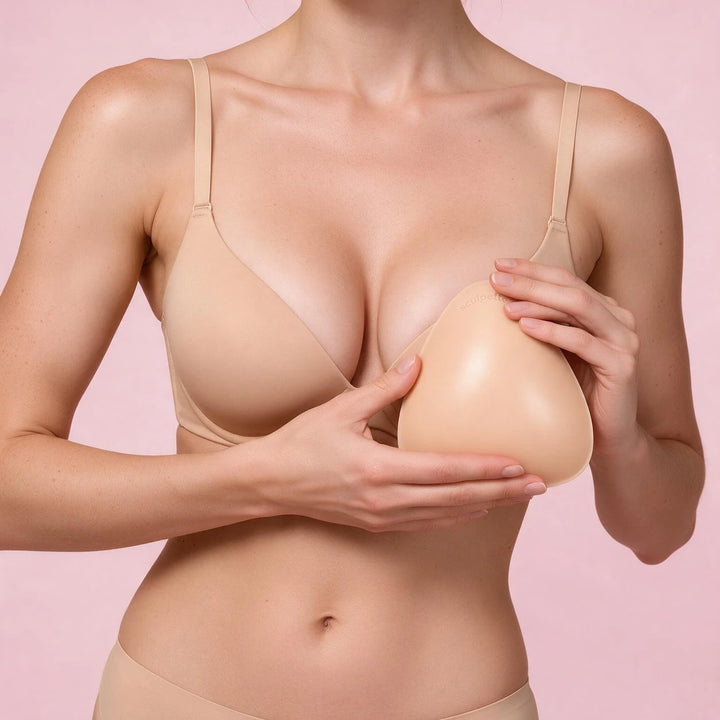
The Sculpt, the fully padded shape in the range. Ten sizes, AA to I.
The mechanism is unremarkable, which is part of why it works. A padded silicone shell sits under the breast rather than over it, and carries the weight upward. Nothing crosses the back or the shoulders, so nothing has to survive a backless dress.
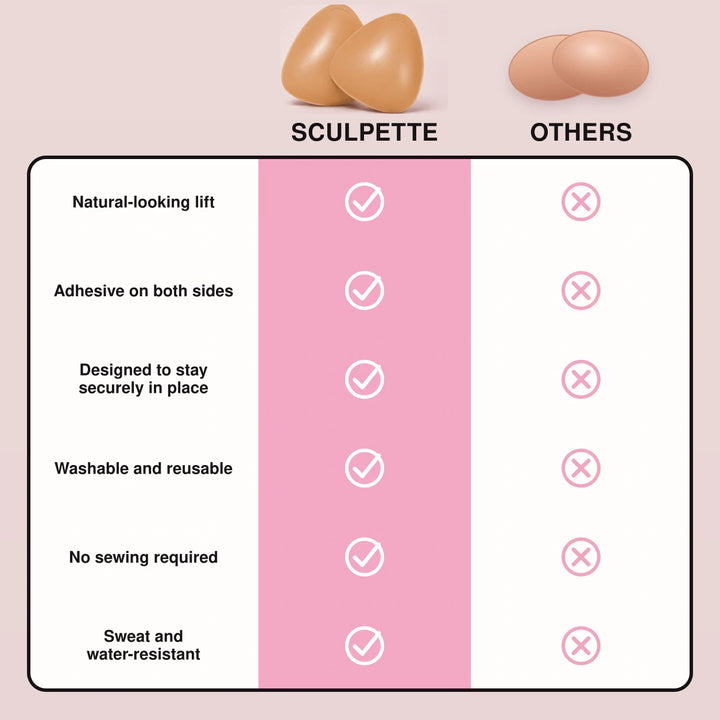
It is held by adhesive on both faces. One side grips skin; the other grips the fabric of the dress. Held from two directions instead of one, it does not migrate over the course of an evening, which is the failure most women have already experienced with a cheaper insert.
Sizes follow cup volume, not the letter printed on your bra. A 32D and a 36B hold the same amount and take the same insert — which is why the range runs AA to I rather than S, M, L. Five shades, from Porcelain to Cocoa. The edges are feathered and the finish is matte, so nothing prints through fabric and nothing rides above a neckline.
Rinse it with water, no soap, let it air dry on the film it came on, and the adhesive comes back. Forty or more wears from one pair. That is the whole difference between a decision you finance and one you keep in a drawer.
Who this is actually for
It fits if
- You have wanted a fuller shape for years and never went through with it.
- You got as far as a consultation, a quote or a savings account, and stopped.
- You had implants removed and want the shape back on your own terms.
- You want it for weddings, events and the dresses in the back of the closet — not for every Tuesday.
It does not fit if
- You want the result permanently, in a t-shirt, at the gym, without putting anything on.
- You are looking for a medical alternative to surgery. This is clothing, not treatment.
- You have sensitive or broken skin, or you are pregnant or breastfeeding.
We would rather lose the sale than have that sentence come as a surprise after it ships.
Loved by 50,000+ happy customers


I stopped tucking the strap in
I used to shove my bra strap into the cup and hope it stayed. This lifts from underneath and it looked like me, just better. Still holding at the end of the night.
 Nicole R.Vancouver, BCVerified


Nothing showed under the fabric
I wanted support without a line anywhere. Wore them all day and never once went to the bathroom to fix something.
 Madison K.San Diego, CAVerified


It held through the dancing
Strapless dress, full reception, and I danced. I kept waiting for something to slip and it just didn't.
 Emily J.Chicago, ILVerified
Questions women ask first
Is this supposed to replace surgery?
No, and we would rather say so plainly. It is an adhesive insert that changes how an outfit fits while you are wearing it, and comes off at the end of the night. What it replaces, for a lot of women, is the feeling that surgery was the only way to get that look.
Will it hold all night?
Adhesive on both faces — one side to your skin, the other to the fabric — so it is held from two directions instead of one. Press for ten seconds a side when you put it on; body heat is what sets the grip.
How do I know my size?
Sizes follow cup volume, not the letter on your bra: a 32D and a 36B hold the same amount and take the same insert. Take your true size — only size down if you sit between two. Going up does not add lift, it adds an edge that shows through fabric.
Does it work for larger cup sizes?
We go to I. The lift is most dramatic through the middle of the range, and it still shapes and holds at the top of it.
How many times can I wear one pair?
Forty or more. Rinse with water, no soap, air dry on the film it came on, and store it flat. Peel from the corner and never the middle.
What if it is wrong for me?
Thirty-day fit guarantee. Wear it once and send it back if the fit is not right. Free US shipping over $25, and a real person answers within one business day.
The look, for the nights that matter
Fifteen seconds, up to two cup sizes, and it comes off with the dress. Ten sizes AA to I, five shades, and thirty days to decide it was right.
See The SculptSourcesU.S. Food & Drug Administration, “Things to Consider Before Getting Breast Implants” and “Risks and Complications of Breast Implants,” including the boxed warning required from October 2021. · U.S. Food & Drug Administration safety communication on squamous cell carcinoma and lymphomas in the capsule around breast implants, 8 September 2022, updated March 2023. · American Society of Plastic Surgeons, average surgeon fee for breast augmentation and annual procedural statistics. · Patient-reported total cost data, RealSelf. · National Geographic and the National Center for Health Research on the rise in breast implant removal. · Consultation fees are a published industry range and vary by surgeon; some surgeons do not charge one.
This page is published by Sculpette and is advertising for a product we sell. It is not medical advice, and nothing here is a claim about the safety of any medical device or about what will happen to any individual. Talk to a doctor about any surgical decision.